Architecture
This document explains how blobber is structured internally and how the pieces fit together.
Design Philosophy
Blobber follows the UNIX philosophy: do one thing well. The core responsibility is moving files to and from OCI registries efficiently. Everything else—authentication, caching, compression—is delegated to focused components.
Package Structure
blobber/
├── doc.go              # Package documentation
├── client.go           # Client type: orchestrates operations
├── image.go            # Image type: cached reader for remote images
├── push.go             # Push operation
├── pull.go             # Pull operation
├── options.go          # Functional options
├── compression.go      # Compression type constructors
├── entry.go            # FileEntry type
├── errors.go           # Sentinel errors
├── registry.go         # Registry interface
├── archive.go          # Archive interfaces
├── safepath.go         # Path validation interface
└── internal/
    ├── registry/       # ORAS-backed registry implementation
    ├── archive/        # eStargz build/read implementation
    ├── safepath/       # Path security validation
    └── cache/          # Blob caching
Core Interfaces
Blobber defines interfaces that abstract the underlying implementations:
Registry
type Registry interface {
    Push(ctx context.Context, ref string, layer io.Reader, opts *RegistryPushOptions) (string, error)
    Pull(ctx context.Context, ref string) (io.ReadCloser, int64, error)
    PullRange(ctx context.Context, ref string, offset, length int64) (io.ReadCloser, error)
    ResolveLayer(ctx context.Context, ref string) (LayerDescriptor, error)
    // ...
}
Handles all OCI registry communication. The default implementation uses ORAS.
ArchiveBuilder
type ArchiveBuilder interface {
    Build(ctx context.Context, src fs.FS, compression Compression) (*BuildResult, error)
}
Creates eStargz archives from filesystems.
ArchiveReader
type ArchiveReader interface {
    ReadTOC(r io.ReaderAt, size int64) (*TOC, error)
    OpenFile(r io.ReaderAt, size int64, entry TOCEntry) (io.Reader, error)
}
Reads eStargz archives, extracting the TOC and individual files.
PathValidator
type PathValidator interface {
    ValidatePath(path string) error
    ValidateExtraction(destDir string, entries []TOCEntry, limits ExtractLimits) error
    ValidateSymlink(destDir, linkPath, target string) error
}
Security validation for paths and extraction operations.
Data Flow
Push Operation
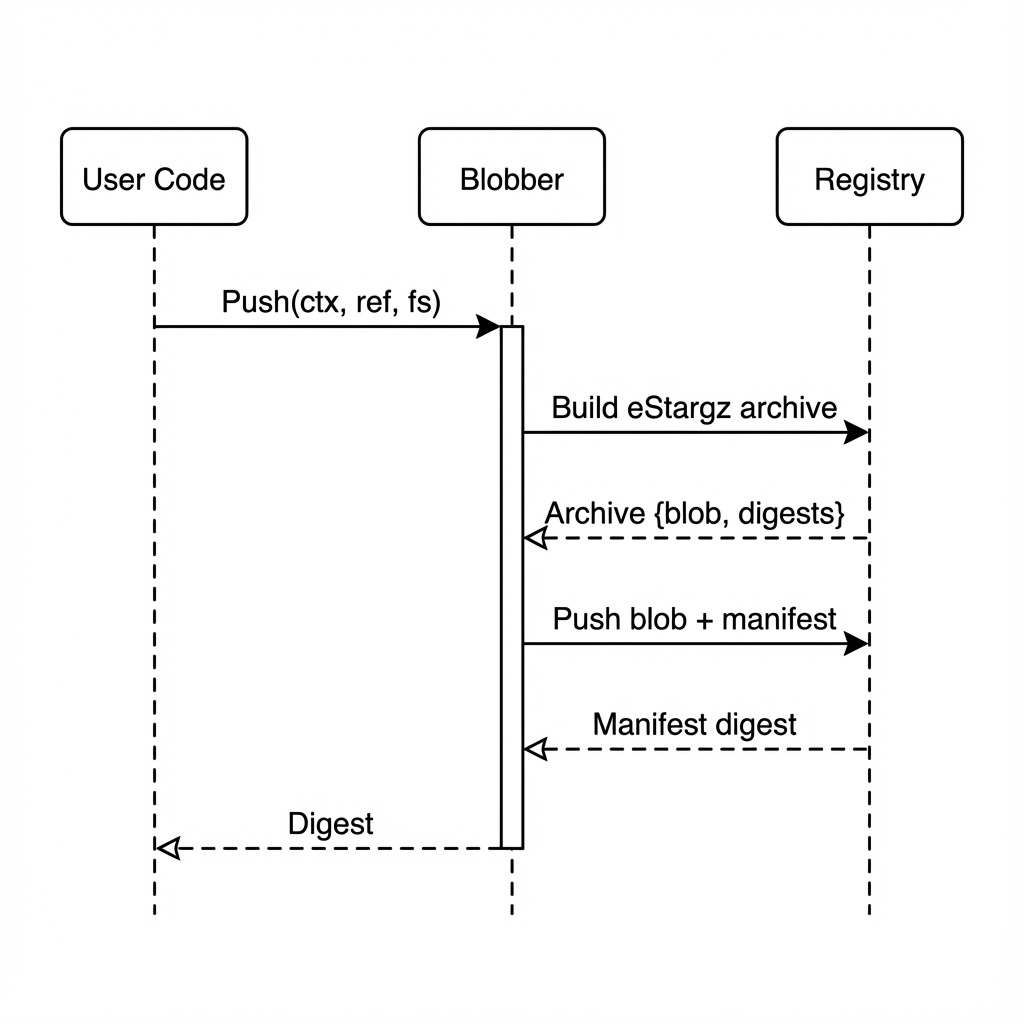
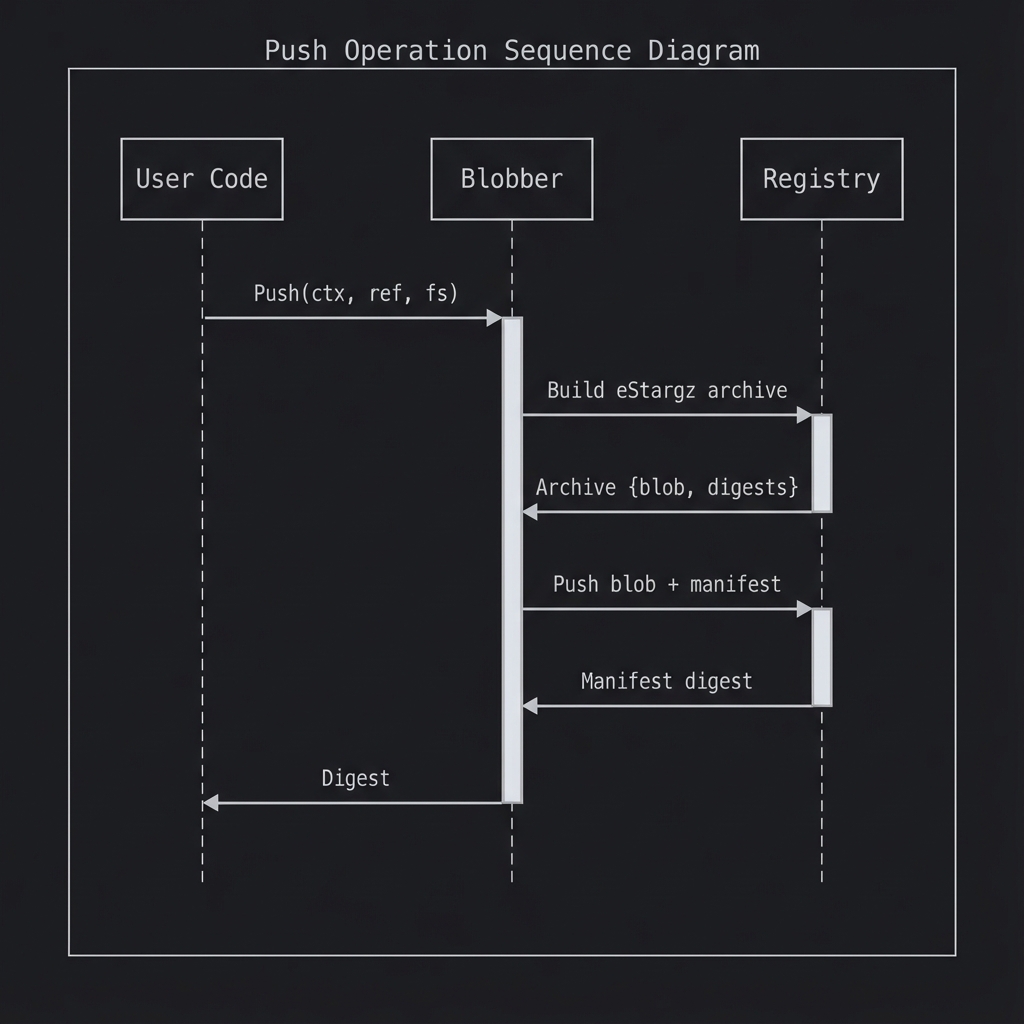
- User provides an
fs.FSand reference - ArchiveBuilder creates eStargz blob, computing digests
- Registry pushes blob, then manifest
- Returns manifest digest to user
OpenImage + List
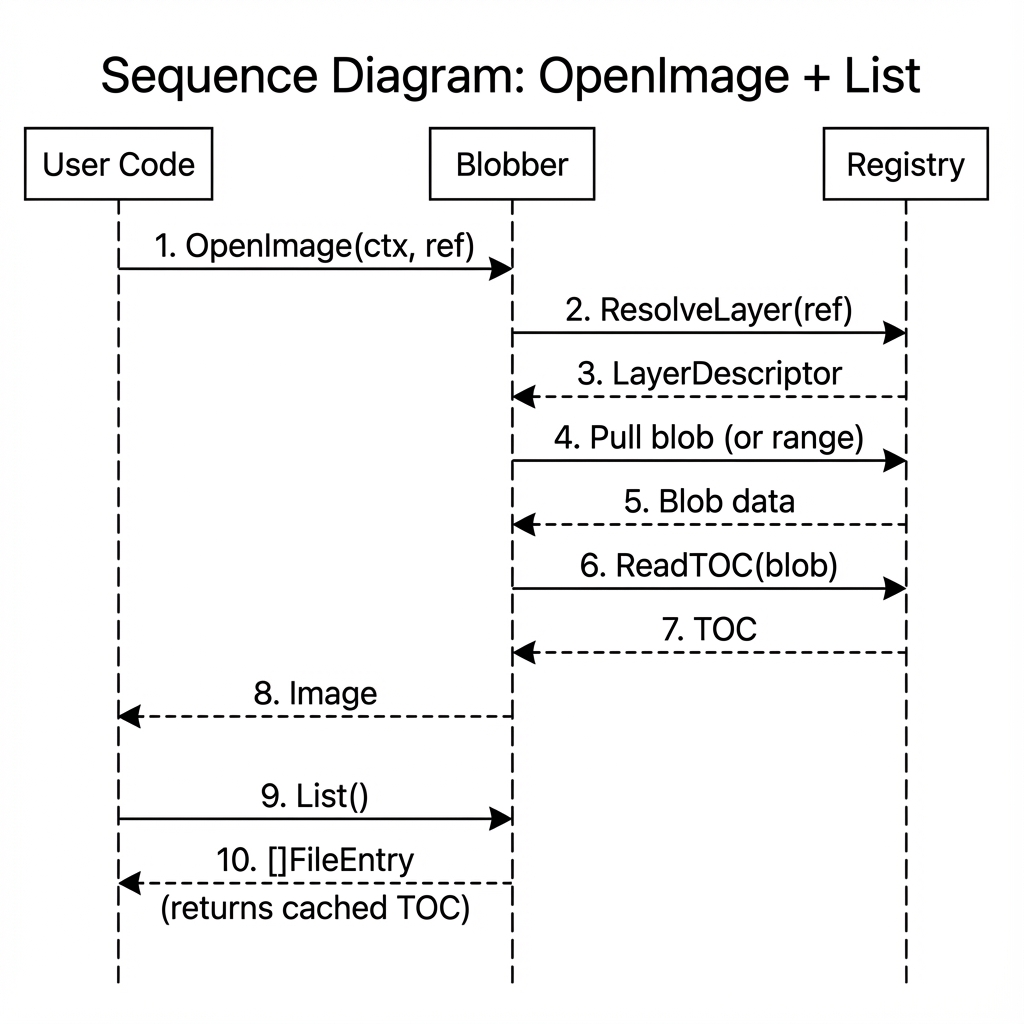
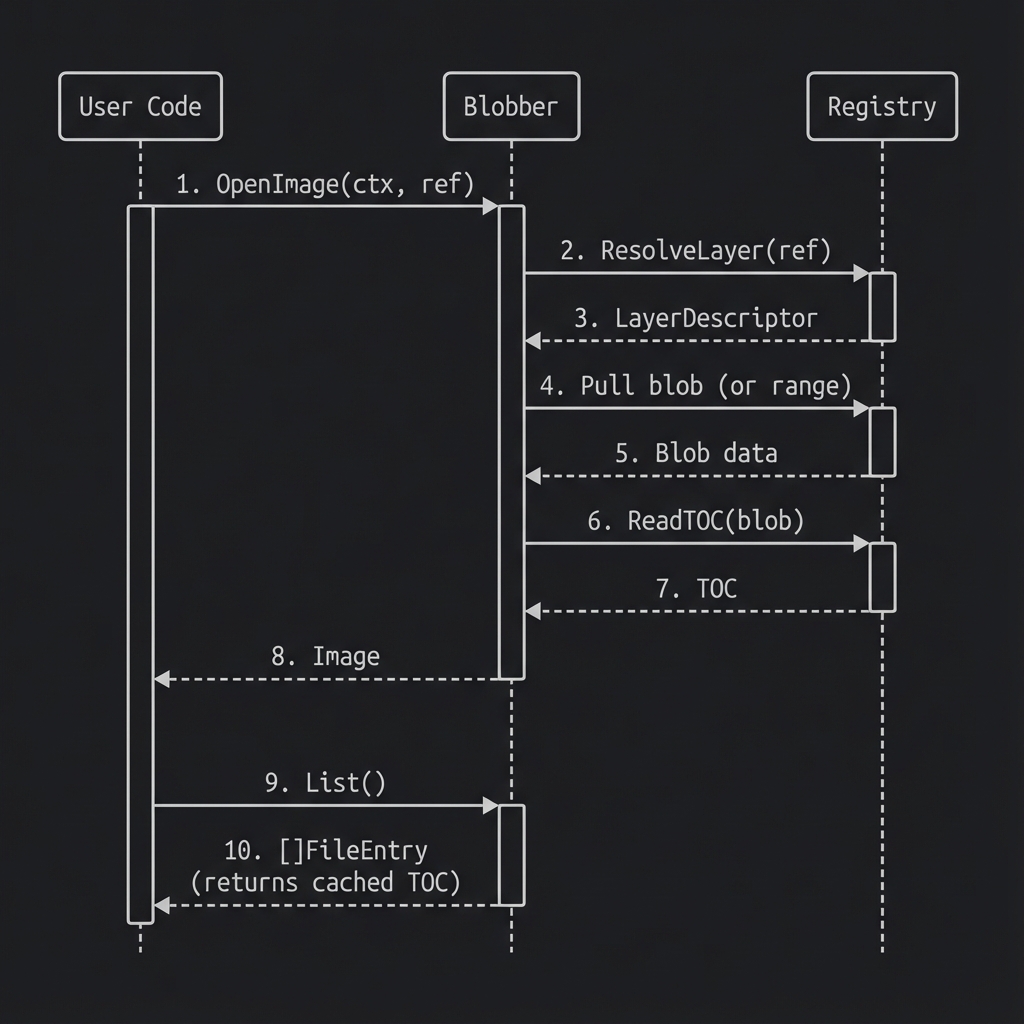
- User requests to open an image
- Registry resolves the reference to a layer descriptor
- Blob is fetched (full or partial depending on lazy loading)
- TOC is extracted from the blob
- Image object caches the TOC and reader
- Subsequent List/Open calls use cached data
Open (Selective Retrieval)
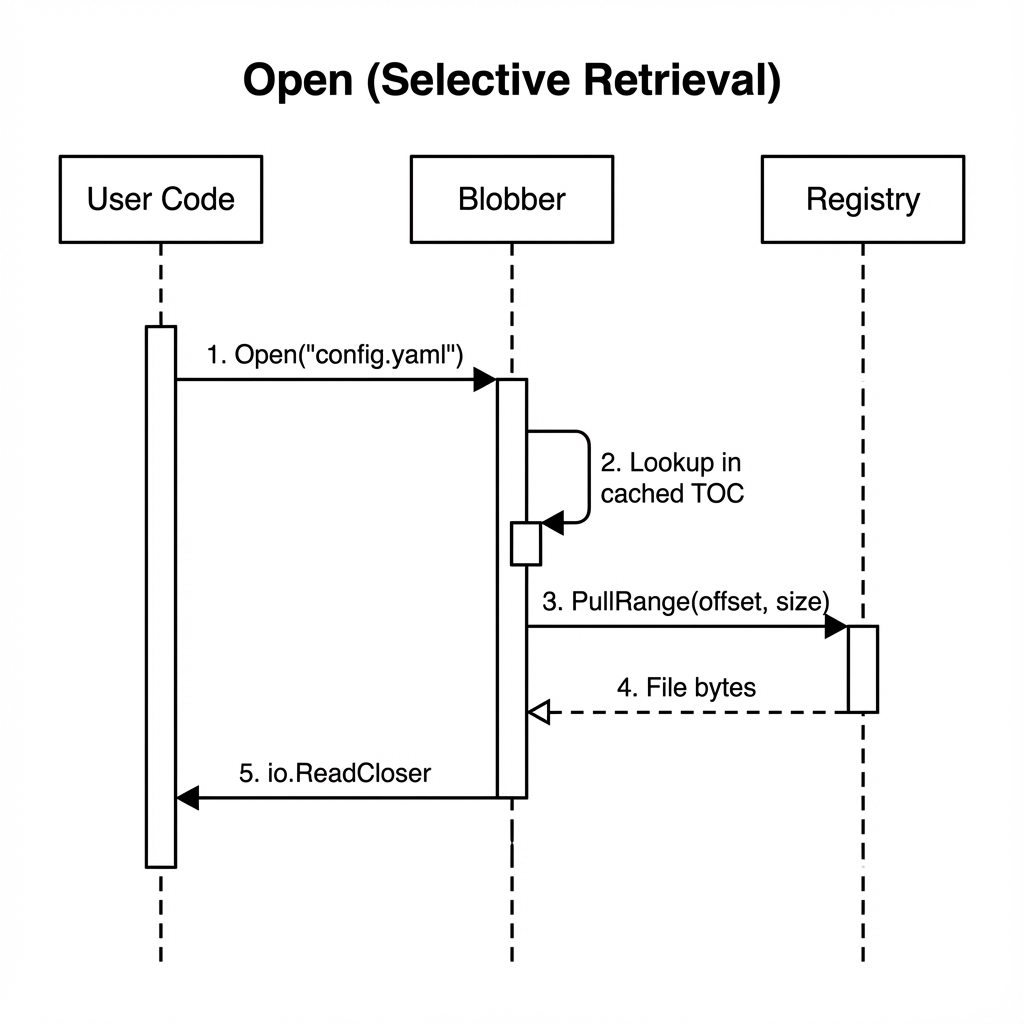
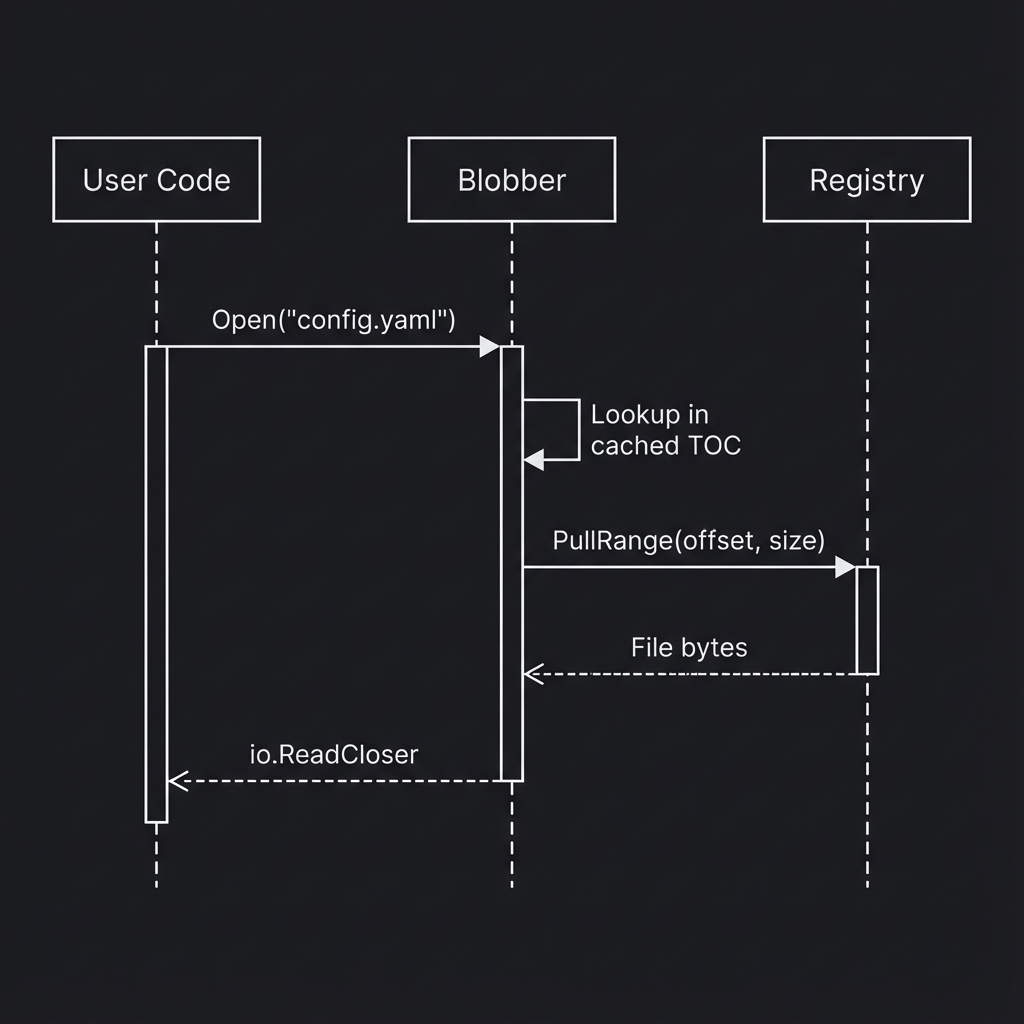
- User requests a specific file
- Blobber looks up the file's location in the cached TOC
- Only that file's bytes are fetched via range request
- Returns reader to user
Security Model
Path Validation
All paths are validated before use:
- No traversal -
..components rejected - No absolute paths - Must be relative
- No null bytes - Prevents injection
- Symlink containment - Targets must stay within extraction directory
Extraction Limits
Prevents resource exhaustion:
| Limit | Default |
|---|---|
| MaxFiles | 100,000 |
| MaxTotalSize | 10 GB |
| MaxFileSize | 1 GB |
Limits are checked before extraction begins using TOC metadata.
Caching
Blob Cache
When enabled, downloaded blobs are stored locally:
~/.blobber/cache/
├── blobs/sha256/<digest>      # Blob data
└── entries/sha256/<digest>.json  # Metadata
Benefits:
- Skip re-downloading unchanged images
- Faster repeated operations
- Reduced network usage
Descriptor Cache
Optional in-memory cache for layer descriptors:
- Avoids re-resolving the same reference
- Trade-off: may return stale results for mutable tags
Dependency Injection
The Client accepts interface implementations, enabling:
- Testing - Mock registry for unit tests
- Flexibility - Custom implementations if needed
- Isolation - Each component testable independently
type Client struct {
    registry     Registry
    builder      ArchiveBuilder
    reader       ArchiveReader
    extractor    Extractor
    validator    PathValidator
    // ...
}
Error Handling
Errors are wrapped with context at each layer:
// In registry layer
return fmt.Errorf("resolving manifest: %w", err)

// In client layer
return "", fmt.Errorf("push failed: %w", err)
Sentinel errors enable precise handling:
if errors.Is(err, blobber.ErrNotFound) {
    // Handle not found
}
See Also
- About eStargz - The format that enables selective retrieval
- Why OCI Registries - Registry benefits
- Library Reference - API documentation